I had the opportunity last week to talk with executives in the cars classified ads market. They let garages, as well as private car owners, pay to advertise their cars on their website, which drags a sizeable audience. This is what we call “classified ads”, applied to cars.
These executives intend to enter a mature market, with two customer segments:
professionals, usually garages
private individuals
Differentiate!
Anyone with the task to enter a market should be looking for differentiation.
Obviously, the market dynamics are very different on the two segments: garages tend to operate through a flat-fee, yearly subscription, and may not churn that often. On the other hand, private individuals do not sell cars everyday, therefore it is important to be visible to them, as they may place their ads on any platform without prior knowledge, while proposing a one-shot fee for an ad.
The advertiser remains blind
Meanwhile, “classified ads” is a double-sided business model: ads attracts audience, and audience attracts ads. Therefore, it is striking to see that, on the studied market, no single site advertises about their actual audience. The advertiser remains blind. Differentiation opportunity #1.
Also, for the car hunters (the “audience”), it is easy to see how many results are returned for a search, except that you need to actually know what you are looking for. It can be inferred that, should differentiation be the key to success, this particular point was a low-hanging fruit.
Asking for the right question
Typically, a cars classified website asks the visitors what kind of car they want. A sedan? An SUV? A coupé ? These are all wrong answers to the wrong question. As the user comes with a particular usage in mind. Therefore, it should be possible to ask: “What would you use your next car for?”. It may be : “Go to work”, “Bring kids to school” (how many?), “Go on extended vacation” (and carry 3 luggages, 2 kids and drive 6 hours in a row), “Go to IKEA and carry pieces of furniture”, etc. Then, the added value of the site would be to score the cars for the above-mentioned usages. Differentiation opportunity #2.
Car classified ads is pretty much the same in every country. It is striking that little has been done to meet the customers’ needs, and avoid copying others. The visitors have to manage their own needs, with very little help. As such, let’s hope that someone comes with a better solution for all future car buyers.
There is no question that the iPhone is being disrupted by Android copycats. As the theory of disruption states:
an inferior product comes in, undercuts the market prices and finds its niche
slowly, the inferior product becomes “good enough”, as the customers’ needs don’t increase as much as the products improve
at the end, the disrupted company is relegated to an expensive niche
Facing the risk to be relegated to an expensive niche, should Apple decrease the iPhone prices?
Android phone manufacturers have done all that: with an average selling price around $200 for Android phones in 2018, iPhones are 3x more expensive than Android ($610 on average). Meanwhile, the iOS market share of smartphone remains at 52% at best (US), stagnates at 25% in China, and is not much better in Europe. There are even countries where market entry is still happening, due to local market barriers, such as in India.
Actually, while pushing for $1600 phones (!), Apple also widened its product offering. As you can see in the graph below, the maximum price for the flagship iPhones is increasing every year:
However, at the same time, Apple keeps selling older models at a stable entry price, around $500:
This allows Apple to have something to sell in front of Xiaomi, Samsung and the likes. The iPhone 7 was introduced in 2016, so it is heading to its 3rd year of product lifecycle.
Outdated phones?
How can Apple, who fights for the top spot of innovation in the phone industry, can sell 3-year old models at twice the Android ASP, without hurting its brand? Believe it of not, Apple is actually 1-to-2-years ahead compared to the competition.
Or leading the race?
As you can also see from various benchmarks, the iPhone 7 has a multi-core benchmark of 5741 points in Geekbench, which corresponds to a Xiaomi Mi 8 SE (released June 2018), or a Huawei P10 Plus (released Feb 2017). This is what allows Apple to keep its products on the market for so long: it just keeps producing old models, which have a good year before the competition catches up. And of course, Apple keeps releasing iOS updates for over 6 year-old phones. CPU speed is only one aspect of the phone performances, but battery and GPU are also to the top level, even for older iPhone models. An iPhone 7 is actually much better at running Fortnite than many recent Android phones.
So, should Apple decrease its iPhone prices? Well, it does, kind of. It is keeping a very competitive mid-market product portfolio, composed of older models. Meanwhile, it is raising the bar for the top end, maintaining margins at unparalleled levels.
How about services?
Another factor to consider is that iPhones tend to last longer than Android counterparts. Roughly 50% of iPhones are more than 2 years old, retaining an economic value a year longer than Samsungs‘ (already not the low end of smartphone). So, there would be 1 billion iOS devices out there, half of Android’s but not one third, as gross sales volumes might suggest.
With the launch of new services by Apple (News+, TV+, a credit card), it remains to be seen if Apple should enlarge its userbase in order to get additional recurring revenues. Only it can know how to maximize the value. It is bound to the price elasticity of the iPhone, i.e. how many percent more do they sell, when they decrease the price by 1%. And also, of course, the take up rate of the new services, soon to be discovered. Two very interesting numbers to find out, indeed, as time unfolds.
So to avoid disruption, Apple is changing the playing field: services may allow for more affordable iPhones, while proposing a wealth of services that no other manufacturer can match.
« I disapprove of what you say, but I will defend to the death your right to say it ». This maxim is wrongly-attributed to Voltaire. And it might just be what Google needs. Indeed, the current Google situation is a typical situation of Innovation vs Dogma.
Back to facts
In the course of the summer 2017, a memo by Google employee James Damore leaks out, stating that (in short) women are biologically not meant to be engineers…
James Damore gets fired
Google CEO Sundai Pichar needs to cancel a company-wide interactive session about gender discrimination, after several employees complained that they would not be able to express their views without retaliation from fellow employees.
Quick disclaimer
Just to set things straight: this blog is not about opinions. However, we think it relevant to point to scientific research which prove James Damore wrong. Also, we can’t emphasize enough how women greatly contributed to science and computing. Marie Curie and Dame Stephanie Shirley are enough to ridicule the whole career achievements of James Damore.
Google wanted so much to be inclusive that it got exclusive
But back to Voltaire: an innovative company must allow anyone to feel comfortable being who they are, regardless of political opinions. The Google situation is a meaningful management lesson: Google wanted so much to be inclusive that it got exclusive.
It is hard for a company that excels so much in not paying taxes to pretend to work for the good of humanity. Kittens don’t replace schools, hospitals or roads — and these are paid by taxes. “Don’t do evil” was Google’s mantra — which Steve Jobs rightfully called “Bullshit”.
Nevertheless, from a very cynical business perspective, Google needs inclusive values, because:
It is good for its image. When your whole business is based on spying on people, and that the NSA leverages that to get info on millions of citizens, you needs to work on how you are perceived by society.
It promotes a culture of performance. Not matter who you are, we only value what you produce.
It increases resources in the long term. Exclude women and your world is 50% smaller. Add to this non-caucasians, homosexuals, and republicans, and you’ll be quickly in shortage of workforce and customers.
The problem is that embracing inclusiveness may be dogmatic, when it means that alternative opinions are excluded. For example, some moderate conservatives start to feel uneasy working at Google. Being inclusive to this extent is being exclusive.
Instead, Google needs to worry about its innovation culture. It needs to make sure that inclusiveness applies to its employee’s careers. If James Damore was not valuing any woman engineer, maybe his job performance would show it. This is when communication does not replace action. James Damore may have been fired to quickly close the topic, it may actually have opened a pandora box and create a deadly fight internally to the company.
Democracy and capitalism
In order not to do evil, Google needs to learn to actually be inclusive: by paying taxes, by participating in society at large without taking part in the debate, and by enforcing performance metrics that are affected by inclusiveness. In short, accept not to be in control of everything, as long as it allowed the debate to take place. Let’s call that … democracy?
The Innovator’s Dilemma is an innovation classics, having defined the term of disruption and made Clayton Christensen famous. It is not only a recommended reading, must also a recommended re-reading. A lot has happened since it was published in 1997, and although it has been heavily criticised since then, I find it still relevant in most situations. Obviously management science is no deterministic science, and no theory covers all cases flawlessly. But the disruption theory applies to many domains pro-actively, which makes it incredibly relevant. Note that I read the 1997 version, and other, more modern editions might have tried to broaden the scope of disruption — but I’ll stick to the original “Eureka” version.
In short…
There are countless summaries of their book on the Internet, so I’ll stick to my own take-aways:
Disruption is powerful, in that well-managed companies fall in the trap of getting trapped in a high-end niche when trying to best serve customers and optimise resource allocation.
Disruption happens when a cheaper alternative, albeit with lower performance, appears on the market. It first requires to look for alternative applications and customers that installed players overlook. But the performance increases faster than the customers’ needs, and ultimately the cheap alternative becomes good enough for the mainstream market. Having matured to something that the incumbent can no longer reproduce easily, they end up… well, disrupted.
Strategies to resist disruption require a separate organisation that grows independently: mainstream resource allocation would systematically priorize other projects for existing customers, and the disrupting products cannot initially promise significant revenue generation for a corporate behemoth. It needs to work like a start-up.
Ultimately, when the disrupting product becomes good enough for the mainstream, the choice criteria change. For example, once hard drive all become reliable enough for most applications, other factors might become more important in customer choice, such as price/MB or speed.
There are interesting numbers about gross margins in a given “Value Network” (i.e. stakeholders of a value chain), inferring that partners’ margins are heavily structured by their other partners’ own margins. Good to know before exploring new markets (or “just follow the money”, as they say…).
Afterthoughts
Although incredibly useful, this book does not predict the future: it just explains what happens in case of disruption, and give directions on how to manage a corporation successfully to survive disruption. However, it cannot predict when a new technology is disruptive. Let’s list a few randomly-chosen examples:
Video streaming: once low-quality and missing content, now Netflix is disrupting TV. One can see how hard it will be for TV channels to catch up, having failed to defend their fortress.
Low-power wide-area Networks: LoRa or SIGFOX propose very low-bandwidth, low-power wireless networks with very low cost structure. Today, these networks are find for certain IoT use cases, but they are far from supporting e.g. a phone call,. However, with technology advances, why not imagine them suitable for mid-rate data transfer ? Then it would be disruptive for existing, more traditional networks.
Digital cameras: bridge cameras are becoming higher-end, lower volume products, while smartphone cameras are taking over. A clear case predicted by the theory: the lower-quality tech is getting good enough for mainstream, taking volumes away from traditional players, which are flying to quality.
Presentation remotes: some people spend up to $80 for a presentation remote. But there are mobile apps that allow to change slides and perform other simple tasks such as timing the presentation. While far inferior in ease of use or features than a traditional remote, these apps are… free ! Definitely a candidate for disruption, provided there is a business model for these apps.
One more thing…
As strange as it sounds, the original iPhone was not a disruption, according to this book. The iPhone was not any cheaper than then-existing smartphones, but was simply superior in term of user experience (reminder: the first version was lacking MMS or 3G, which Nokia phones had had for a long time). So, disruption is not the only way to gain market share. Blue Ocean Strategies, anyone ?
It has been over 22 years that an executive from SUN Microsystems stated that “The Network is the Computer”. However, I would infer that this statement only made sense when applications started to move into the Cloud. With that transition, the “Network” has become what supports applications, i.e. an Operating System. It is therefore relevant to consider the Network as a Platform, which is what all successful OS have become. And this is the exact positioning that telcos have been looking for in the digital game.
Today’s networks work like single-purpose computers
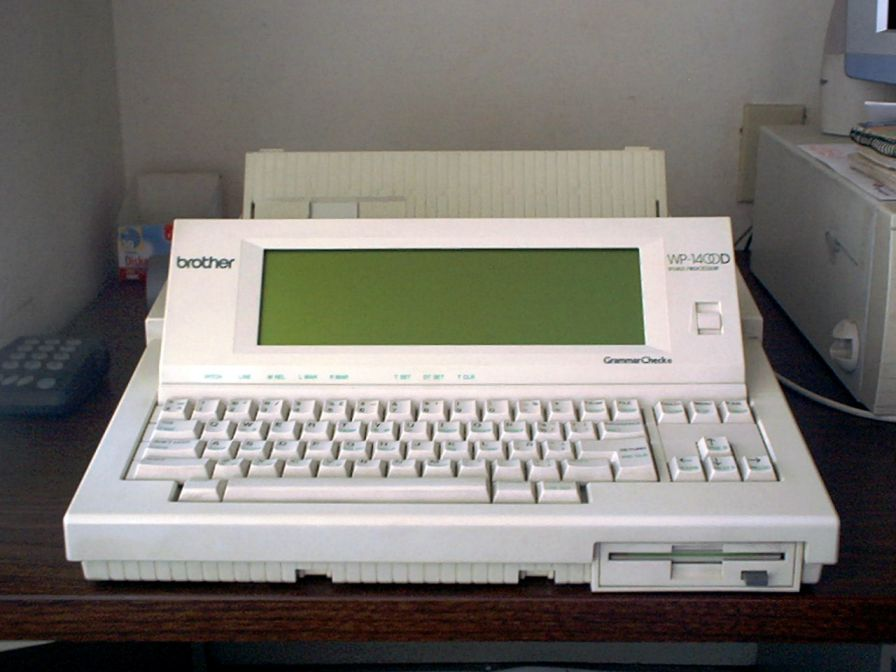
If you would like to set up a corporate network today, and would like to avoid running it over the Internet, your preferred telco will sell you a single-purpose network custom-configured to your needs. This is pretty much the same as when editors were buying typewriters, which were essentially single-purpose computers: hard to upgrade, operating as standalone, just waiting for deprecation.
This is what a typewriter looked like (c. 1994)
Now that your corporate network is set up, optimised for your needs and budget, try to add a cloud application:
most will settle for VPN or https connections to the chosen cloud provider. But if you send your data flows over the Internet, why have a corporate network in the first place ? This is where the threat really lies with OTT (Over-the-top providers).
the richer ones will buy dedicated links to the cloud provider, and run a 6-month integration project to get an exclusive network-engineered access to their beloved cloud application. Expensive and not really easy to setup. Add such access to another 4 or 5 cloud providers, and you’ll have fun, guaranteed.
use a Cloud Exchange. Almost there, but they come with their own set of drawbacks.
A Cloud Exchange is like running MS-DOS
A Cloud Exchange is basically an enhanced router that will link you to a vast number of Cloud providers on-demand. Companies such as Equinix took care of connecting to hundreds of such provider. You just need to connect to the exchange, access the management console and configure the link between your network and the cloud provider.
Although a cloud exchange is a great step forward toward using the network as the platform supporting your Cloud applications, it is not quite perfect:
you usually need to buy a hosting service in the same datacenter as the exchange, before being able to access to it;
you still need to engineer the data flows yourself, and it is easy to create a bottleneck if you settle for just one connection point;
There is a limited number of IT managers who can configure the cloud exchange for their company. not great when a business unit just wants to access their cloud application — they might not tell the IT department and will end up with insecure access clogging the Internet gateway;
last but not least, you are still the integrator: you configure the exchange, you order your cloud service separately, you pay two separate invoices (one to the cloud exchange provider, another one to the cloud provider), and of course you are the ping pong ball between the two providers’ customer support centres.
This is what MS-DOS looked like
All in all, Cloud Exchanges feel a lot like using MS-DOS, for those who know what it meant (c’mon, it’s not that old). Lots of configuration tweaking and debugging nights. Let’s say it is a glimpse to what Network as a Platform could do.
Putting the user experience back in the game
As a corporate user, all I would like is to subscribe to a cloud service, and let the network configure itself “auto-magically”. Obviously the telco’s and the IT department’s network and security rules could be taken into account, if any.
Let’s say that I am at the office using Salesforce. It is not hard for the network to recognise my session as a Salesforce session, and route it adequately over a telco-operated Cloud Exchange. Technologically, there is no reason why this cannot be done. Indeed, Network as a Platform is all about partnerships and strategic vision.
Implementing Network as a Platform
To implement Network as a Platform, all it takes to a network operator is:
to define a wholesale API that cloud providers can use to trigger a network reconfiguration whenever the business customer asks for it. There are secure ways to do so and it allows secure connectivity on-demand between the corporate network and the cloud provider.
to leverage existing routing capabilities in the MPLS backbone, and later with SDN, to route the flows to each Cloud provider as required.
to convince the cloud providers to interconnect to the telcos’ networks. This is arguably the hardest part, as Cloud providers don’t like to deal with network access. Large telcos will have an edge in convincing the cloud powerhouses to open up. Others should get access to the datacenter without much effort, but might have to pay for a long distance link to reach it. Either way, the associated costs will ultimately be factored in into the wholesale services sold to the Cloud provider, and paid for by the end customer.
Network as a Platform is the way to avoid network commoditisation
As explained before, there is little incentive to run a corporate network when all the apps are accessed through the Internet. Therefore, if telcos want to avoid consumer-grade pricing of their corporate network services, they should market it as a platform, much like the Operating System of the cloud: provide interfaces (API) to cloud services providers, and get out of the way when the customers wants to access an app.
Note to myself: were I in charge of a telco’s future, I would rest uneasy realizing how little the effort to standardize my network interfaces with cloud service providers.
PS: telcos like acronyms — let’s talk about NaaP : Network as a Platform. 🙂
I don’t usually read books about “how to see life differently”, but I liked the idea that an original-minded trader (by background) wrote about the role of randomness in life. “Fooled by randomness” is just that: a (sometimes cynical) view of our lives from the eyes of a statistician.
The Author
Nassim Nicholas Taleb is most famous for his previous work about unlikely events — “The Black Swan”. A former trader, he nows teaches at NYU and feeds trolls on Twitter. Of Mediterranean culture, seemingly extensive thereof, he excels in seeing things in their wholesomeness, not just events by events. This was the philosophy of the Black Swan, and it is still present in this book.
The Takeaways
The book is a constant reminder to check real facts against their probability of occurence, before jumping to conclusion about their cause. Several phenomenons are at work in building well-accepted-but-false theories out of observation:
Randomness: while people might use complicated theories to explain visible successes, they might just be the result of the number of agents at play. Then, there is always a slight probability that you are observing a small-but-visible sample of that large number set. Imagine that 10 000 traders play the casino on foreign-exchange rates. Out of this quantity, a marginal number will almost surely come up with impressive results. Their big bonuses and acclaim will make them more visible that the losers. Add cognitive biais to this, and you get a false theory that might seem to explain their success.
Cognitive biais: several biaises are at play, but few of them seem of particular importance:
survivor biais: we usually don’t talk about the losers, just about the winners. When you see a traders who “made it”, you may not see all those who got fired because of their poor performance;
risk/loss aversion: we may make the wrong choices by fear of losing out. As a trader specialised on unlikely events with big impact (the “black swans”), the author shares the pressure he gets while investors see minor loses on his portfolio while others (the “random fools”) are in the green. This may be the case most of the time. Until that time when he makes up in a few weeks several times what the “random fools” made in the previous years. The example that comes to mind is the one where traders make $5M every year during several years, enjoy promotions and big bonuses, until their theories turn out to malfunction and they lose $30-50M in a few weeks. Over time they clearly lost their investors’ money in hot-air theories, but investors do prefer this way, rather than to accept losing little during several years until a disproportionate reversal of fortune. Think of it next time your friend shows off how much s/he made on the stock market;
induction: we tend to expect the future to be a continuation of the past. We all heard that “real-estate market will never go down”. Until it does. This may be intuitively a particular case of the fact that our brains like linearity — while many things are non-linear;
environmental biais: we have greater chances to live in environments where people are similar to us. Therefore, our house may never seem big enough (“the neighbour has a new car”…), our fortunes never seem to be as good or bad as they actually are.
Laziness : the medias are particularly held responsible to spread biaises. The striking example is how they have to explain the direction of the stock market with whatever news of the day. They can’t justify their existence by just saying that we are observing noise. This makes reading news much less important. Obviously this applies to many managers in larges companies, or politicians, etc. trying to take credit for random events.
Personal opinion
If you have a background in statistics, and have read recent books about cognitive biases, you may not feel like you will learn a lot in this book. Let’s just say that it is a kind reminder. I found the writing style not particularly pleasant, but I will nevertheless keep this book as a reference when confronted to random fools. It is not often that these things are dealt with altogether in one convenient place.
According to car manufacturers or large software companies, the self-driving cars are around the corner. What was still a science-fiction research field 15 years ago — my university had such project, led by AI guys walking bare feet and called “the crazy guys” — is now meeting massive capital influx, mindshare from top scientists and consumer momentum. Such cars are being testedlivein real roads in California, and now even Switzerland.
But as always in innovation, there are adoption barriers, and they do exist for the self-driving car. Assuming the technology will ultimately work, the main remaining barrier is probably the law: in most countries, you are supposed by law to remain in control of your vehicle. This is a key principle for insurance companies to assess responsibilities in a crash. Easy to overcome, you would think ? not quite. For even technology-mature solutions that over-perform established ones may not make it because of regulations.
Side mirrors are an artefact from the past
As an example, every car has a artefact from the past which should no longer be here: side mirrors. If they had to be invented today, side mirrors would probably not make it to market.
Imagine that side mirrors don’t exist. Drivers need to turn their heads to look at what is coming up behind. A marketing manager identifies it as a customer pain, and asks engineers to find a solution. One comes up with the side mirror — but it comes with its own collection of issues:
it will decrease the performance of the car, as it increases the air-penetration ratio. So, the gas consumption will have to increase, say, by 0.5L per 100km.
it will impact manufacturing, which will find it more difficult to hold a mirror on the side of the car, rather than having a flat surface.
Mirrors will break regularly, generating other sets of customer pains.
oh, and by the way, there will still be blind spots, so you will have to put a disclaimer about how poorly it is addressing the issue.
Obviously the marketing manager will ask the engineering team to reconsider. Needless to say, small webcams would be much more efficient to solve this issue — as is the case for going backward in some cars. Some concept cars already support this solution.
So, why are side mirrors still very present in cars ? Because they are compulsory. The law says that cars must have side mirrors. And law has the single biggest kind of inertia that can be. From such regulation, e.g. insurance companies built their processes, defined ways of dealing with others and, ultimately, to cover the risks.
Side mirrors show us what could happen to self-driving cars
The side mirror gives us a glimpse of what it means to have a technology-mature solution that don’t make it to market because of the law. And this could very well be the case with self-driving cars. Actually, you can read more about what happens with side mirrors and regulations at this page.
With that said, we are not even accounting for the difficulties for regulators to certify self-driving algorithms (imagine Apple with a great algorithm, Google with another one, but when put together the cars end up making incompatible choices that end up in crashes). And once you find out how to certify them, which will probably a lengthy process, how do you deal with software updates every once in a while to fix a security issue?
So, it won’t be before long that you see self-driving cars : regulation need to change for this to happen and this typically takes a lot of time. Actually, we don’t even know how to even regulate self-driving cars. This requires to make choices about people’s safety, and this is the last thing that regulators and politicians like to do.
In the corporate world, a lie may be a quick way to seemingly boost results or reach a milestone. But truth be told, it has no such effect: it just creates the illusion of it. The problem with a lie is that it forces you to keep the truth secret. Because of this, in large organizations, you quickly have to treat your employees at the same playing field as the general public, i.e. you have to lie to your employees. When you lie as a manager, you are hiding potentially key info to your employees, making it impossible for them to be smartly processing this info.
I witnessed such behavior right before the launch of the 4th mobile operator in France. One consultant was advising an incumbent telco about their strategy to resist the launch of this new competitor, which turned out to be brutal. The momentum (hope?) in that company, at the time, was that customers would pay them more because they enjoyed quality customer service. The new entrant was supposedly appealing only to geeks, and this incumbent was obviously better. Or not. Thing is, the employees had ended up believing their own marketing lies. Any customer of this incumbent could see that customer service was on par with others’, sometimes even worse. Nevertheless, the corporate momentum was that they had some quality customer service. As a result, they expected to charge a premium for a non-existent quality customer service. Obviously, customers could see what employees had been taught not to question, and this incumbent suffered massively from the launch of the new entrant. Indeed, it was left with no strategy to counter the new entrant, because employees were living with a false perception of reality — one that the marketing department had been proud to build with expensive ads !
Similarly, imagine the investment committee at Volkswagen evaluating the investment of a few million euros in a more efficient diesel engine: why bother, since they are already so good at making diesel engines ? Clearly, this kind of lies tricks the company into not working on real issues.
A lie promotes the wrong people
In your company, which one is more likely to get promoted: the one that plays with cookie jars to consistently match result expectations, or the one that accepts the volatility of her results with a clear understanding of the weaknesses ? If it’s the former, I would suggest to look for a better place. For two reasons:
the promoted liar may have tricked the management based on fake data, but operational teams cannot be fooled so easily. As a result, this puts a non-leader in a management position. Good people will leave (bad ones always stay) and results will fall down one way or the other.
the promoted liar knows how she got promoted, and will apply her broken ethics in other situations. After all, it is easier to lie than to get the job done. Fail to spot these toxic managers, and soon your organization will be full of them.
Innovation needs honesty
One key part of the innovation process is that ability to detect and priorize the right issues. Broken ethics and corporate lies distort this process. That is why innovators don’t lie. They humbly recognize weaknesses and work on them. An innovative organization knows how to reward such behavior, while being merciless with bad ethics.
A major part of the infrastructure supporting the digital revolution is designated as “the Cloud”. Far from being solely virtual, it is composed of brick-and-mortar servers and hard drives, hosted in massive datacenters and consuming huge amounts of power (no, these clouds don’t fly). The largest player in this infrastructure space is Amazon Web Services, weighting an estimated $6 Billions of revenues in 2015 — more than its 4 largest competitors combined. It has two European presences, one in Ireland and another in Germany. France, in its Colbertist tradition — or was it arrogance ? — decided that this could not happen freely, and had to be shaped by a government-mandated effort. This has made sovereign cloud a top-down failure.
In 2009, the French government unlocked €150M to build a France-based cloud, a sizable sum for a budget running a constant deficit. Orange, Thalès and Dassault Systems were listed as co-investors. But as a sign of things to come, Dassault Systems pulled back, and we ended up with 2 projects instead of one:
Cloudwatt (Orange + Thalès)
Numergy (SFR + Bull — now Atos)
Each project received €75M each of taxpayers’ money.
While so many companies struggle to raise money, this innovation process raises eyebrows:
First question: if €75M was enough to start anything, why grant €150M in the first place ?
Second: why start such a projet, when the 3rd web hoster on the planet is French ? Yes, there was already an extensive Cloud infrastructure in France, and we could have helped the best become global faster.
Third: what is Europe doing ? Such subsidies distort competition and are not supposed to happen.
Truth be told, I can’t help thinking that insane friendship between politicians and VPs at these companies was involved. But I don’t want to even find out — for fear of shame of being French.
So let’s take the best out of this experience: I am not talking about cheap second-hand server hardware, but rather learning. What went wrong ?
Simply, innovation does not happen by just deciding it. Money does not buy an innovative environment. I will remember that:
Numergy and Cloudwatt took years to just catch-up with Amazon or OVH technically. Forget about being better as a late contender.
“Fish rots head first”: the project was ill-conceived, but the executives that were hired where not any better. There is no product differentiation, just expensive and inefficient TV campaigns, no presence on the field…
Telcos: I hear a lot of telcos willing to deploy their own Cloud infrastructure. Fair enough, but look at Numergy and Cloudwatt as possible outcomes of these initiatives. There has to be another way.
This has been barely noticed during the last Apple keynote, but the next wave of iPhone 6s will feature an optional monthly plan to pay for the device. Apple has massive amounts of cash out of the US, which it is not in a hurry to repatriate, so it clearly has the deep pockets for such a strategy globally. All this will come with something already seen on the last iPad: the Apple SIM. Now that Apple is taking over the distribution of mobile subscriptions, Mobile Network Operators (MNO) may rightfully feel threatened to be dwarfed into a last mile provider, while Apple rips the profits of distributing mobile plans. But this is not a done deal: there are ways that MNO may fight back. So, how can MNOs deal with the Apple SIM ? Here are a few ways to explore.
What is the Apple SIM ?
Before moving forward on this topic, let’s be more specific about what we are talking about. The Apple SIM is nothing new conceptually, at it operates like a technology called eUICC — all on a standard SIM package. eUICC is fully standardized by the GSM Association, and sold by leading vendors such as Gemalto.
In short, the eUICC technology allows for reconfigurable SIM cards with the help of cloud technologies. You may know that your SIM card embeds the private crypto-key of your mobile provider — one that allow to uniquely identify you on the network. On a traditional SIM, this private key is hardware-coded on a chip, which is a highly secure way to distribute it in millions of SIM while still keeping it unreadable (the way the key is used in mobile auth protocols is beyond this article).
In the case of the eUICC, an entity called “service manager” securely and remotely pilots the private key in use inside the chip. This allows two nice features:
the MNO can be reconfigured in your device remotely, without any physical interaction;
once this tech is widely accepted by MNO, you actually don’t need a SIM card anymore: an eUICC module could be soldered anywhere on your phone’s motherboard — which saves space and makes design more simple.
In the Apple SIM, as you may have guessed, Apple is the service manager of the SIM, and the MNOs are back to their main role in the chain: mobile service providers.
Why eUICC is a big deal for MNOs ?
Mind you, Mobile Network Operators already use the eUICC technology: in M2M applications, where you need global coverage for thousands of devices scattered all over the country, including in rural areas, it could be nice to get coverage from just the telco that’s there. Some connected electricity counters, for example, may be reconfigured to connect to the network with the best signal wherever it stands, without having to manage a stock of SIM cards and manually insert them on the field. It was also chosen by the EU in its connected car recommendation. Actually, all the main MNOs have signed up for the eUICC standard by the GSMA.
What MNOs are worried about is the use of eUICC in the B2C space, because it is disrupting the distribution of the mobile plans. There are two issues at stake here:
Telcos have traditionally developed an extensive retail distribution network through a large number of self-branded stores, which are either self-owned or franchises — and they are turning useless;
A service manager with significant market power might extract more value than what MNOs currently pay for acquiring customers. Apple might fall in that category, as it “owns” the premium segment (80% market share for devices above $300). Apple also showed in the past that it is not scared to impose stringent conditions on telcos that just want to distribute its phones (although it hurt its competitors more than the telcos actually).
The end of MNO retail stores
Sure, the eUICC makes the retail store irrelevant, as distribution happens online (through a portal managed by the service manager). But as it stands, the store is already largely irrelevant in mobile distribution, for at least four reasons:
Online stores are already on the rise, if only for price comparison. You may still buy your SIM in the store because you don’t want to wait for delivery, but you choose your offer online anyway. In many developed countries, the customer does not buy a phone plan, it buys a mobile device with a consumer credit. Find the best offer online, and the store no longer “sells” you anything, it is just part of the logistic chain.
MNO stores were once relevant when offers where complicated and people did not know how to insert a SIM in their phones. But it turns out that complexity have decreased and customers have become more tech-savvy. This makes the store pretty much useless on two of its main missions.
In many mature markets, prices declined sharply, which leaves less money to pay for a brick&mortar distribution channel. A retailer used to make up to €250 for acquiring a new customer with a 2-year commitment. This is no longer possible when unlimited (unsubsidized) plans run at €20/month, as is the case in some countries. Add a subsidy worth €20/mo, and pay the distributor the equivalent of €10/mo for a 2-year commitment, and it sells for €50/mo instead of €20/mo. When you are 2.5x times more expensive than the standard offer, you are targeting a niche, at best. Most likely, irrelevance is at the doorstep.
In many countries, the market share of plans without commitment have increased drastically. For example, in France, 2/3 plans are not under commitment any more — up 100% in the last few years. Although one clear driver
has been competition and the launch of a 4th MNO, it is also the result of a longer lifetime of the smartphone. The following chart by mixpanel.com shows that iPhone 4/4s/5, launched 3 to 5 years ago, still account for roughly 40% of users in the US. With a churn rate of 30-35% in pospaid, this confirms that people now change plans more often than devices.
Evolution of iPhone mix in App user base. source: mixpanel.com
In brief, it is fair to say that the lower utility factor of MNO stores is not a result of the eUICC, but rather the logical result of endogenous factors. The danger of eUICC is that the irrelevancy of retail stores is brutally translated in facts: nobody needs to get a SIM in the store anymore. Plus, should customers want to remain in brick&mortar channels, why would they tie themselves to one single MNO brand ? It used to be for the subsidy, but if this can be had from the device manufacturer, why bother ?
Focus on the customer, not the channel
The main recommendation to MNO is not to fight the eUICC tidewave, but rather to embrace an “adopt and adapt” strategy:
MNO need to rethink their retail strategy. Customers no longer need these stores as such, therefore they should either find another “raison d’être”, or prepare to close them altogether. New missions could be to service defect phones, sell used/reconditioned devices, solve specific customer problems as a differentiator, etc. All this requires different skills than what’s currently in place. But without proper repositioning, MNO should start shortening lease agreements, sell stores to franchisees, and stop operating retail stores altogether.
MNO need to work on the best way to acquire customers on the eUICC’s service manager portals. There is clearly an opportunity to work with Apple on this, as this would legitimate its technology. MNO need to define the most attractive offers (subsidy or price ? / Unlimited vs segmentation, etc.) and marketing strategies for this channel.
MNO need to focus fully on customer satisfaction, and upsell ! Although Apple can influence the choice of a carrier, it does not control which plan is used at any given time by a user. If the MNO sells a low-cost plan at first, it could increase its margin by converting the user to a higher-end tier. The example of FreedomPop in the US is striking, as it is able to convert a large number of freemium customers to a paid offer by optimizing its communication to the enrolled users. MNO should allow self-configuration through an easy application on the device to combine unlimited usage and budget control.
All in all, the best way to shine in the eUICC world is to be desired by the customer. This, Apple cannot fight, or at its own expense. MNO can shield themselves against abuse of power from Apple by learning to use this new distribution channel fully, instead of entering a dogmatic war against it — which at the end is a war against the user’s experience.
As Apple will start to subsidize its own devices, MNO should anticipate the associated extra cash flow — as they will subsidize less devices. Up to them to invest in customer experience, or to take the short-sighted path of exceptional dividends…
Doing more with less requires an innovation process