I had the opportunity last week to talk with executives in the cars classified ads market. They let garages, as well as private car owners, pay to advertise their cars on their website, which drags a sizeable audience. This is what we call “classified ads”, applied to cars.
These executives intend to enter a mature market, with two customer segments:
professionals, usually garages
private individuals
Differentiate!
Anyone with the task to enter a market should be looking for differentiation.
Obviously, the market dynamics are very different on the two segments: garages tend to operate through a flat-fee, yearly subscription, and may not churn that often. On the other hand, private individuals do not sell cars everyday, therefore it is important to be visible to them, as they may place their ads on any platform without prior knowledge, while proposing a one-shot fee for an ad.
The advertiser remains blind
Meanwhile, “classified ads” is a double-sided business model: ads attracts audience, and audience attracts ads. Therefore, it is striking to see that, on the studied market, no single site advertises about their actual audience. The advertiser remains blind. Differentiation opportunity #1.
Also, for the car hunters (the “audience”), it is easy to see how many results are returned for a search, except that you need to actually know what you are looking for. It can be inferred that, should differentiation be the key to success, this particular point was a low-hanging fruit.
Asking for the right question
Typically, a cars classified website asks the visitors what kind of car they want. A sedan? An SUV? A coupé ? These are all wrong answers to the wrong question. As the user comes with a particular usage in mind. Therefore, it should be possible to ask: “What would you use your next car for?”. It may be : “Go to work”, “Bring kids to school” (how many?), “Go on extended vacation” (and carry 3 luggages, 2 kids and drive 6 hours in a row), “Go to IKEA and carry pieces of furniture”, etc. Then, the added value of the site would be to score the cars for the above-mentioned usages. Differentiation opportunity #2.
Car classified ads is pretty much the same in every country. It is striking that little has been done to meet the customers’ needs, and avoid copying others. The visitors have to manage their own needs, with very little help. As such, let’s hope that someone comes with a better solution for all future car buyers.
The Innovator’s Dilemma is an innovation classics, having defined the term of disruption and made Clayton Christensen famous. It is not only a recommended reading, must also a recommended re-reading. A lot has happened since it was published in 1997, and although it has been heavily criticised since then, I find it still relevant in most situations. Obviously management science is no deterministic science, and no theory covers all cases flawlessly. But the disruption theory applies to many domains pro-actively, which makes it incredibly relevant. Note that I read the 1997 version, and other, more modern editions might have tried to broaden the scope of disruption — but I’ll stick to the original “Eureka” version.
In short…
There are countless summaries of their book on the Internet, so I’ll stick to my own take-aways:
Disruption is powerful, in that well-managed companies fall in the trap of getting trapped in a high-end niche when trying to best serve customers and optimise resource allocation.
Disruption happens when a cheaper alternative, albeit with lower performance, appears on the market. It first requires to look for alternative applications and customers that installed players overlook. But the performance increases faster than the customers’ needs, and ultimately the cheap alternative becomes good enough for the mainstream market. Having matured to something that the incumbent can no longer reproduce easily, they end up… well, disrupted.
Strategies to resist disruption require a separate organisation that grows independently: mainstream resource allocation would systematically priorize other projects for existing customers, and the disrupting products cannot initially promise significant revenue generation for a corporate behemoth. It needs to work like a start-up.
Ultimately, when the disrupting product becomes good enough for the mainstream, the choice criteria change. For example, once hard drive all become reliable enough for most applications, other factors might become more important in customer choice, such as price/MB or speed.
There are interesting numbers about gross margins in a given “Value Network” (i.e. stakeholders of a value chain), inferring that partners’ margins are heavily structured by their other partners’ own margins. Good to know before exploring new markets (or “just follow the money”, as they say…).
Afterthoughts
Although incredibly useful, this book does not predict the future: it just explains what happens in case of disruption, and give directions on how to manage a corporation successfully to survive disruption. However, it cannot predict when a new technology is disruptive. Let’s list a few randomly-chosen examples:
Video streaming: once low-quality and missing content, now Netflix is disrupting TV. One can see how hard it will be for TV channels to catch up, having failed to defend their fortress.
Low-power wide-area Networks: LoRa or SIGFOX propose very low-bandwidth, low-power wireless networks with very low cost structure. Today, these networks are find for certain IoT use cases, but they are far from supporting e.g. a phone call,. However, with technology advances, why not imagine them suitable for mid-rate data transfer ? Then it would be disruptive for existing, more traditional networks.
Digital cameras: bridge cameras are becoming higher-end, lower volume products, while smartphone cameras are taking over. A clear case predicted by the theory: the lower-quality tech is getting good enough for mainstream, taking volumes away from traditional players, which are flying to quality.
Presentation remotes: some people spend up to $80 for a presentation remote. But there are mobile apps that allow to change slides and perform other simple tasks such as timing the presentation. While far inferior in ease of use or features than a traditional remote, these apps are… free ! Definitely a candidate for disruption, provided there is a business model for these apps.
One more thing…
As strange as it sounds, the original iPhone was not a disruption, according to this book. The iPhone was not any cheaper than then-existing smartphones, but was simply superior in term of user experience (reminder: the first version was lacking MMS or 3G, which Nokia phones had had for a long time). So, disruption is not the only way to gain market share. Blue Ocean Strategies, anyone ?
It has been over 22 years that an executive from SUN Microsystems stated that “The Network is the Computer”. However, I would infer that this statement only made sense when applications started to move into the Cloud. With that transition, the “Network” has become what supports applications, i.e. an Operating System. It is therefore relevant to consider the Network as a Platform, which is what all successful OS have become. And this is the exact positioning that telcos have been looking for in the digital game.
Today’s networks work like single-purpose computers
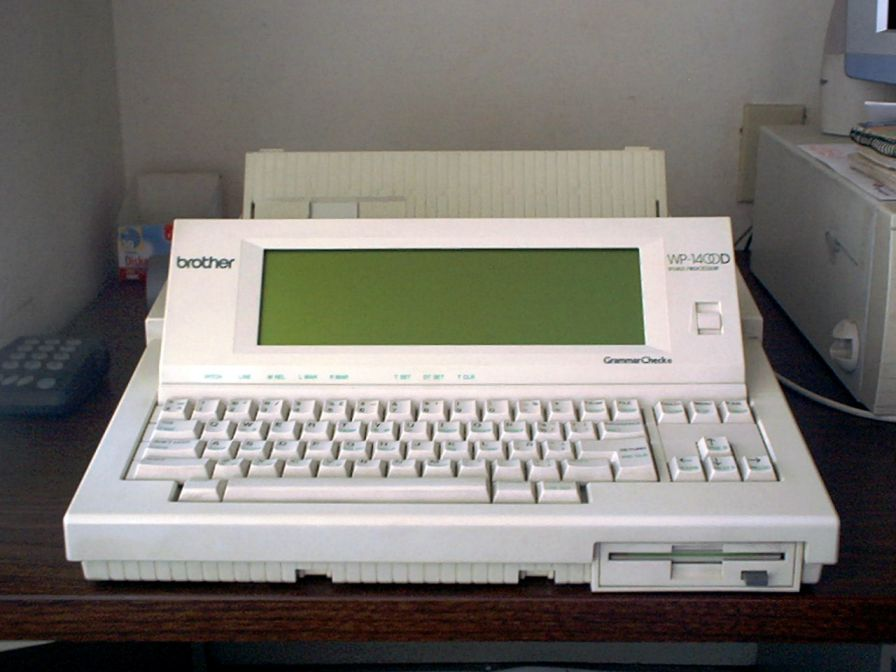
If you would like to set up a corporate network today, and would like to avoid running it over the Internet, your preferred telco will sell you a single-purpose network custom-configured to your needs. This is pretty much the same as when editors were buying typewriters, which were essentially single-purpose computers: hard to upgrade, operating as standalone, just waiting for deprecation.
This is what a typewriter looked like (c. 1994)
Now that your corporate network is set up, optimised for your needs and budget, try to add a cloud application:
most will settle for VPN or https connections to the chosen cloud provider. But if you send your data flows over the Internet, why have a corporate network in the first place ? This is where the threat really lies with OTT (Over-the-top providers).
the richer ones will buy dedicated links to the cloud provider, and run a 6-month integration project to get an exclusive network-engineered access to their beloved cloud application. Expensive and not really easy to setup. Add such access to another 4 or 5 cloud providers, and you’ll have fun, guaranteed.
use a Cloud Exchange. Almost there, but they come with their own set of drawbacks.
A Cloud Exchange is like running MS-DOS
A Cloud Exchange is basically an enhanced router that will link you to a vast number of Cloud providers on-demand. Companies such as Equinix took care of connecting to hundreds of such provider. You just need to connect to the exchange, access the management console and configure the link between your network and the cloud provider.
Although a cloud exchange is a great step forward toward using the network as the platform supporting your Cloud applications, it is not quite perfect:
you usually need to buy a hosting service in the same datacenter as the exchange, before being able to access to it;
you still need to engineer the data flows yourself, and it is easy to create a bottleneck if you settle for just one connection point;
There is a limited number of IT managers who can configure the cloud exchange for their company. not great when a business unit just wants to access their cloud application — they might not tell the IT department and will end up with insecure access clogging the Internet gateway;
last but not least, you are still the integrator: you configure the exchange, you order your cloud service separately, you pay two separate invoices (one to the cloud exchange provider, another one to the cloud provider), and of course you are the ping pong ball between the two providers’ customer support centres.
This is what MS-DOS looked like
All in all, Cloud Exchanges feel a lot like using MS-DOS, for those who know what it meant (c’mon, it’s not that old). Lots of configuration tweaking and debugging nights. Let’s say it is a glimpse to what Network as a Platform could do.
Putting the user experience back in the game
As a corporate user, all I would like is to subscribe to a cloud service, and let the network configure itself “auto-magically”. Obviously the telco’s and the IT department’s network and security rules could be taken into account, if any.
Let’s say that I am at the office using Salesforce. It is not hard for the network to recognise my session as a Salesforce session, and route it adequately over a telco-operated Cloud Exchange. Technologically, there is no reason why this cannot be done. Indeed, Network as a Platform is all about partnerships and strategic vision.
Implementing Network as a Platform
To implement Network as a Platform, all it takes to a network operator is:
to define a wholesale API that cloud providers can use to trigger a network reconfiguration whenever the business customer asks for it. There are secure ways to do so and it allows secure connectivity on-demand between the corporate network and the cloud provider.
to leverage existing routing capabilities in the MPLS backbone, and later with SDN, to route the flows to each Cloud provider as required.
to convince the cloud providers to interconnect to the telcos’ networks. This is arguably the hardest part, as Cloud providers don’t like to deal with network access. Large telcos will have an edge in convincing the cloud powerhouses to open up. Others should get access to the datacenter without much effort, but might have to pay for a long distance link to reach it. Either way, the associated costs will ultimately be factored in into the wholesale services sold to the Cloud provider, and paid for by the end customer.
Network as a Platform is the way to avoid network commoditisation
As explained before, there is little incentive to run a corporate network when all the apps are accessed through the Internet. Therefore, if telcos want to avoid consumer-grade pricing of their corporate network services, they should market it as a platform, much like the Operating System of the cloud: provide interfaces (API) to cloud services providers, and get out of the way when the customers wants to access an app.
Note to myself: were I in charge of a telco’s future, I would rest uneasy realizing how little the effort to standardize my network interfaces with cloud service providers.
PS: telcos like acronyms — let’s talk about NaaP : Network as a Platform. 🙂
This has been barely noticed during the last Apple keynote, but the next wave of iPhone 6s will feature an optional monthly plan to pay for the device. Apple has massive amounts of cash out of the US, which it is not in a hurry to repatriate, so it clearly has the deep pockets for such a strategy globally. All this will come with something already seen on the last iPad: the Apple SIM. Now that Apple is taking over the distribution of mobile subscriptions, Mobile Network Operators (MNO) may rightfully feel threatened to be dwarfed into a last mile provider, while Apple rips the profits of distributing mobile plans. But this is not a done deal: there are ways that MNO may fight back. So, how can MNOs deal with the Apple SIM ? Here are a few ways to explore.
What is the Apple SIM ?
Before moving forward on this topic, let’s be more specific about what we are talking about. The Apple SIM is nothing new conceptually, at it operates like a technology called eUICC — all on a standard SIM package. eUICC is fully standardized by the GSM Association, and sold by leading vendors such as Gemalto.
In short, the eUICC technology allows for reconfigurable SIM cards with the help of cloud technologies. You may know that your SIM card embeds the private crypto-key of your mobile provider — one that allow to uniquely identify you on the network. On a traditional SIM, this private key is hardware-coded on a chip, which is a highly secure way to distribute it in millions of SIM while still keeping it unreadable (the way the key is used in mobile auth protocols is beyond this article).
In the case of the eUICC, an entity called “service manager” securely and remotely pilots the private key in use inside the chip. This allows two nice features:
the MNO can be reconfigured in your device remotely, without any physical interaction;
once this tech is widely accepted by MNO, you actually don’t need a SIM card anymore: an eUICC module could be soldered anywhere on your phone’s motherboard — which saves space and makes design more simple.
In the Apple SIM, as you may have guessed, Apple is the service manager of the SIM, and the MNOs are back to their main role in the chain: mobile service providers.
Why eUICC is a big deal for MNOs ?
Mind you, Mobile Network Operators already use the eUICC technology: in M2M applications, where you need global coverage for thousands of devices scattered all over the country, including in rural areas, it could be nice to get coverage from just the telco that’s there. Some connected electricity counters, for example, may be reconfigured to connect to the network with the best signal wherever it stands, without having to manage a stock of SIM cards and manually insert them on the field. It was also chosen by the EU in its connected car recommendation. Actually, all the main MNOs have signed up for the eUICC standard by the GSMA.
What MNOs are worried about is the use of eUICC in the B2C space, because it is disrupting the distribution of the mobile plans. There are two issues at stake here:
Telcos have traditionally developed an extensive retail distribution network through a large number of self-branded stores, which are either self-owned or franchises — and they are turning useless;
A service manager with significant market power might extract more value than what MNOs currently pay for acquiring customers. Apple might fall in that category, as it “owns” the premium segment (80% market share for devices above $300). Apple also showed in the past that it is not scared to impose stringent conditions on telcos that just want to distribute its phones (although it hurt its competitors more than the telcos actually).
The end of MNO retail stores
Sure, the eUICC makes the retail store irrelevant, as distribution happens online (through a portal managed by the service manager). But as it stands, the store is already largely irrelevant in mobile distribution, for at least four reasons:
Online stores are already on the rise, if only for price comparison. You may still buy your SIM in the store because you don’t want to wait for delivery, but you choose your offer online anyway. In many developed countries, the customer does not buy a phone plan, it buys a mobile device with a consumer credit. Find the best offer online, and the store no longer “sells” you anything, it is just part of the logistic chain.
MNO stores were once relevant when offers where complicated and people did not know how to insert a SIM in their phones. But it turns out that complexity have decreased and customers have become more tech-savvy. This makes the store pretty much useless on two of its main missions.
In many mature markets, prices declined sharply, which leaves less money to pay for a brick&mortar distribution channel. A retailer used to make up to €250 for acquiring a new customer with a 2-year commitment. This is no longer possible when unlimited (unsubsidized) plans run at €20/month, as is the case in some countries. Add a subsidy worth €20/mo, and pay the distributor the equivalent of €10/mo for a 2-year commitment, and it sells for €50/mo instead of €20/mo. When you are 2.5x times more expensive than the standard offer, you are targeting a niche, at best. Most likely, irrelevance is at the doorstep.
In many countries, the market share of plans without commitment have increased drastically. For example, in France, 2/3 plans are not under commitment any more — up 100% in the last few years. Although one clear driver
has been competition and the launch of a 4th MNO, it is also the result of a longer lifetime of the smartphone. The following chart by mixpanel.com shows that iPhone 4/4s/5, launched 3 to 5 years ago, still account for roughly 40% of users in the US. With a churn rate of 30-35% in pospaid, this confirms that people now change plans more often than devices.
Evolution of iPhone mix in App user base. source: mixpanel.com
In brief, it is fair to say that the lower utility factor of MNO stores is not a result of the eUICC, but rather the logical result of endogenous factors. The danger of eUICC is that the irrelevancy of retail stores is brutally translated in facts: nobody needs to get a SIM in the store anymore. Plus, should customers want to remain in brick&mortar channels, why would they tie themselves to one single MNO brand ? It used to be for the subsidy, but if this can be had from the device manufacturer, why bother ?
Focus on the customer, not the channel
The main recommendation to MNO is not to fight the eUICC tidewave, but rather to embrace an “adopt and adapt” strategy:
MNO need to rethink their retail strategy. Customers no longer need these stores as such, therefore they should either find another “raison d’être”, or prepare to close them altogether. New missions could be to service defect phones, sell used/reconditioned devices, solve specific customer problems as a differentiator, etc. All this requires different skills than what’s currently in place. But without proper repositioning, MNO should start shortening lease agreements, sell stores to franchisees, and stop operating retail stores altogether.
MNO need to work on the best way to acquire customers on the eUICC’s service manager portals. There is clearly an opportunity to work with Apple on this, as this would legitimate its technology. MNO need to define the most attractive offers (subsidy or price ? / Unlimited vs segmentation, etc.) and marketing strategies for this channel.
MNO need to focus fully on customer satisfaction, and upsell ! Although Apple can influence the choice of a carrier, it does not control which plan is used at any given time by a user. If the MNO sells a low-cost plan at first, it could increase its margin by converting the user to a higher-end tier. The example of FreedomPop in the US is striking, as it is able to convert a large number of freemium customers to a paid offer by optimizing its communication to the enrolled users. MNO should allow self-configuration through an easy application on the device to combine unlimited usage and budget control.
All in all, the best way to shine in the eUICC world is to be desired by the customer. This, Apple cannot fight, or at its own expense. MNO can shield themselves against abuse of power from Apple by learning to use this new distribution channel fully, instead of entering a dogmatic war against it — which at the end is a war against the user’s experience.
As Apple will start to subsidize its own devices, MNO should anticipate the associated extra cash flow — as they will subsidize less devices. Up to them to invest in customer experience, or to take the short-sighted path of exceptional dividends…
In a panel I organized about innovation, a major bank’s innovation director explained how the risk for failure had to be borne by the organization itself, not the individual. This raises the question of leadership in innovation, and I would like to illustrate this concept by a concrete example.
Company A is a leader in its market, having internally developed a solution which gathered several awards from recognized institutions. It is widely believed in the company that this solution is key to the commercial success it experiences on its market. So, at the end, everyone feels good about this cost center.
Since company A is so proud about this solution, one considered selling it to other similar companies in different (read: non-competing) geographies. Minimal resources are allocated for over a year to that purpose, and actual revenue objectives given to a business unit. Finally, one day, “out of the blue”, a large company’s top management contacts A to know more about this solution. Their financial advisers had told them about it — always consider investors’ presentation as a marketing tool for your know-how. Company A joins the RFP bandwagon, gets short-listed, and now feels that things are getting serious.
As deal closing gets close to real, everyone at A gets nervous:
the “international” business unit needs to write a contract
the lawyers need to back a deal in a foreign jurisdiction
the technical team worries about committing on a project in someone else’s technical environment
the operations team is wondering how they will work with the customer’s employees and how they will share responsibilities for failures
the CFO needs to deal with a foreign currency and country risks
a “domestic” business unit, whose revenue depend on company A’s solution, fears that it might lose resources and control over the roadmap — with no upside potential.
All this is crystallized when the deal needs board approval as per A’s governance rules. Risks suddenly get over-estimated, and everyone hides behinds the uncertainties. In short, people are telling the board why this new business should be dismissed, instead of explaining how work could be done. So A is in a situation where it spent resources during over a year on a new kind business, but finds itself reluctant to get real when it finally gets a potential customer.
What is needed in this situation is an actual leader.
The role of a leader in innovation is two-fold:
reassure the teams that s/he will be responsible for what will be done. This means protecting the careers of those who will contribute, as well as giving them the right excuse to change the way they work with others. In this case, the domestic business unit has a roadmap and an existing business based on the solution. Having another company profiting from the same technical team means that the engineers will have to priorize some of its requests. These engineers need this leader to explain the hard truth to the domestic business unit, in the company’s general interest. Same thing when/if a feature gets broken as part of incremental software development.
create a team spirit around an ambition. Large structures tend to consider employees as disposable resources, but in this case key resources need to be motivated about this new development. Key contributors need regular updates about the project, a proper kick-off and a good story about where they are heading. Otherwise, why would they bother trading their comfortable, deterministic life against a new set of issues?
As is usually said, leadership is not a given: it has to be taken. Company culture plays an important role in having someone stepping in and be the leader. For example, you may have already seen freshly-nominated directors pretending “to have done that great thing”, much to the deception of the actual do-ers. But when real leadership happens, the impossible gets done: contributors will work smarter and harder to make everyone in the team succeed. Not a given, and not possible in every company, but a clear signal for success.
There are many blogs and publications about digital and its disruptive way to change how we live. This one is a modest effort to contribute to the community, with (hopefully) some different points of view than what can be found in mainstream media. With that said, and not least, it is also a tool for self-improvement for the author, by structuring concepts and exchanging ideas with interested parties.
Before going any further, it is worth emphasizing a few bits of context that may be useful to understand the perspective of this blog:
about Digital: we adhere to the vision first formalized by Carlota Perez that the world is going through the deployment phase of the technical revolution of the digital age. In short, this revolution started by the invention of the transistor, and we are now at the point where the technology is sufficiently mastered and cost-effective for it to spread across all sectors of the economy. This is the moment when institutions and legal frameworks are adapting to the situation.
about Disruption: we will stick to Clayton Christensen‘s definition of disruption. That is, a way by which an initially inferior product or service, albeit with a drastically lower price, takes over well established solutions and becomes the standard. You may think of the PC replacing the mainframe: the PC was less powerful, but much cheaper to own and operate. Clayton Christensen very well described how disruption happens for incumbents. There are many examples of the Innovator’s Dilemma, one most remarkable being Kodak — who invented the very technology that made it irrelevant.
about Innovation: we define innovation as a process aiming at generating a comparative advantage in either cost structure and/or product or service features. This is clearly not just R&D, and it may not even involve new technologies, but at the end it translates in market adoption and (let’s dare say it:) S-A-L-E-S resulting from market traction !
Together, the broad availability of digital know-how, the wide adoption of smartphones (shall we say “pocket computers”?), and the understanding by established elites of what is happening, make blue ocean strategies easier to implement, and opportunities aplenty — all of which are candidates for this blog to talk about.
We hope you enjoy reading this blog. Please do not hesitate to voice up where relevant in the comment section, or even contribute by submitting your own post!
Doing more with less requires an innovation process